Violet Byrd: email
The photographs were made with a consumer quality point-and-shoot instant
Polaroid camera. In that way they resemble snapshots. There is a
difference of intention between the technique of the snapshot - an
exhilarating form of photography in its deep regard for small, familiar
moments of everyday life, or in its offer of proof in the reaching of an
unfamiliar destination – in that the photographer intends to capture a
known subject. These photographs are of small, familiar moments in the
everyday urban landscape, but my intent in making them was to photograph
what had not yet appeared, to freeze random details of constantly changing
occurrences, to see what existed in the few seconds that the camera
blocked my view and substituted its mechanical record for my biological
vision.
Kay Canavino: email
An urban area offers some wonderful geometry to work with, as well as
motion and irony. These photographs of the Castle at Prospect Hill, and
my old neighborhood at Brickbottom, were the results of the challenge to
find the beauty around me in my Somerville environment. The ghost images
of a father and child exploring the Castle at night contrasts momentary
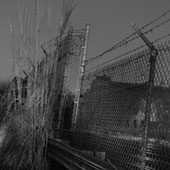
visitors with the solid, permanency of stone. Pampas grass planted by a
hopeful gardener in a sliver of ground struggles with asphalt and a chain
link fence.
I am drawn to the night landscape because there is a different sort of
beauty to be found at night, without the jumble of information visible in
the daylight. Using the elements of black, available light, and the
artificial light that I add, I explore the urban environment to discover
what the night has to disclose.
Karen Davis: email
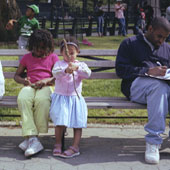
“Child’s Play,” is an on-going series of portraits of childhood. “City
Kids” focuses on those images of children in the urban environment.
I am especially attracted to children’s moments of deep engagement – with
others, an object, a thought. I’ve re-learned from my observations, and
hope to reflect in my images, something I knew as a kid: while adult
memories of childhood may blend into a dreamy confection - a child’s
experience is far more serious business.
Gary Duehr: email
In these photographs, I am interested in the energy created by colliding
vantage points, like a car crash of victims and perpetrators, innocent and
traitors, onlookers and subverters. A handshake might bump into a mob, a
funeral into a bomb’s aftermath.
I want the patchy, rough quality to add to the immediacy, making it harder
to lookaway, even though we might want to.
We feel somehow we shouldn’t gawk
but how could we not
So we do
At what’s tangled, amiss
At what stares back at us
as if through the lens of a camera
Shane Hutton: email
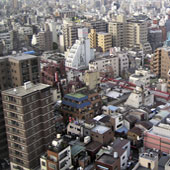
In your home city, life is largely utilitarian. You use buildings that are relevant to you in the way you need to use them and lose a sense of scale. But a foreign city strips the environment of most utilitarian uses and there the full impact of a city's gravity can be felt.
As you look at a foreign cityscape you find yourself wondering what's in all those millions of little boxes. How many coffee tables? How many magazines? How many telephones? How much copper wire is out there? How many packages of Haribo Gold-Bears Gummi Candy?
Futility.
So the thoughts switch. How many people are having sex out there right now? How many are my age? Do I have a doppelganger out there? And you're hooked.
At some point between the gummi bears and who's having sex, a shutter quietly opens and closes.
Robin Radin: email
For over twenty five years I have photographed the cultural landscape of my neighborhood in Jamaica Plain, Massachusetts. My work draws inspiration from the vibrant and diverse lifestyles of the people who live in this urban community. I make portraits of people in the context of their neighborhood; their relationships with family, neighbors and their immediate environment. My photographs examine the complexities of human relations: an acknowledgment that we are simultaneously together as community and family, and alone, as individuals in this world.
Skye Schulte: email
One thing you see with living in the city is the idea of progressive repetition. It builds toward something. It gets complex. It even becomes overwhelming. But as you get to know and learn about a city you start to see those patterns that persist.
This is significant because human behavior is based on patterns.
Everything around us that we touch is a reflection of that: our cities, our buildings, our transportation, and even our stores. All of these are an exoskeleton left by our behavior.
Even when we aren't physically present in the urban environment, our life is echoed in the structures we build around us and in the patterns that we see. We demolish and rebuild our cities just as we demolish and rebuild ourselves. Urban life allows for this constant reinvention and renewal. And it is the persistent patterns in our lives that connect us all.
Andrea Thompson: email
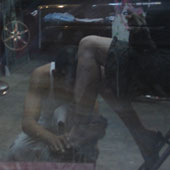
Las Vegas is the city of image, surface, and constantly shifting identities. Here the gaze doubles back on itself: people see themselves being seen, and alter their identities in response to this scrutiny. In Henna Tattoo, Las Vegas, shop windows have caught my image muddled in layers of interior and exterior reflections; and, within the confusion, an unexpectedly tender moment of genuine human contact.
Peggy Tuitt: email
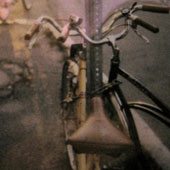
The images included in Urban Interpretations are a selection from a body of over 1,000 images taken during a recent research visit to Cuba. My intent as I embarked on this project was to capture the essence of what is Cuban – its everyday life. Arriving with no preconceptions, I was a voyeur in the truest sense. Over 10 days I made hundreds of photo-sketches a day. I opened my lenses and my heart to experience and document all I encountered moving throughout Havana – the cityscape - its people. It was a pleasure to experience what this timeless and hopeful place had to offer around every corner: the excitement, the people, the bikes, the architecture, the history, the scale, the intimacy, the warmth, the light, the sunsets, the energy, the character, the characters, the spirit, the contradictions and most of all the hope.
Peter Urban: email
Boston is an odd city to photograph. It lacks the iconic parts that speak
to the world; there is no Empire State building, no Golden Gate Bridge.
Other cities have the same cobblestones and gas lamps that we do, the old
wharves and granaries. And, on the other side of the equation, there is
more swoopy titanium, mirror and steel in evidence in other burgs. So the
challenge I set myself was to see this place as a stranger would, to find
the excitement in me and translate that into a rediscovery of my town. It
is a classic city, a classy city. It is in a class by itself.
James Zall: email
The urban environment that wraps itself around us is the product of many
separate decisions made by people, companies and governments over decades
and centuries. Major changes (hills leveled, building lots seized from the
ocean) tend to be recorded and remembered, but not so the myriad of
independent renovation, construction and demolition decisions that stitch,
stretch, pucker or unravel the urban fabric. These images isolate just a
few of the curious juxtapositions that result from these threads of
activity.
|