This show is sponsored by the Somerville Arts Council and the
Massachusetts Cultural Council.
This show was curated by Beth Driscoll of the Lady Cougars Art Gang.
The Nave Gallery's Young Turks returns for a second year with an
exhibition featuring art and artists 'taking a walk on the wild side.' The
show aims to highlight all that is not part of the status quo. The work of
ten artists questions, confronts, and, yes, attacks ideas, images, and
ideology that others take for granted. Built on the joint premise that
dissent can be healthy and rebellion may be messy, YTT artists show work
exploring the world, their position in it and whatever commentary they
feel the need to make on this relationship.
This program is supported in part
by a grant from the Somerville Arts Council, a local agency which is supported by the Massachusetts Cultural
Council,
a state agency.
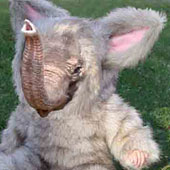
Head Clausnitzer
Digital media allows for the shaping of many different realities, at it
were. It also makes one of the artist’s defined tasks – that of,
exploration and representation of self - more easily attained through the
medium’s barriers destroying creative possibilities.
I was a fat kid. My parents were easy on me in terms of my condition and
so by the time I entered grade school I was not suffering from any lack of
confidence where my body was concerned. But when the girl of my dreams
called me elephant boy every positive thought I had about myself came
crashing down.
My case was not uncommon, never has been and ever will it be so. Perhaps
my predicament could even be thought of as quaint and cute. However,
psychic pain is pain, nonetheless, and an instilled perception of ones
inadequacies bides in an ill way within oneself and has portends for the
adult to come.
Barbara Cone
Penises aren’t generally “public,” or if they are someone is in BIG trouble. Societal prohibition of the display of male genitalia is pervasive and unequivocal, especially in the presence of children.
There are exceptions to the rule of course. The male genitalia pictured in“P.P.’s”* is observed daily by hundreds of thousands of men, women and
children.
Clearly the general public considers these penises to be in good taste.
So, does it follow that the photographic images I present in “P.P.’s”*
cannot possibly be considered offensive because they are simply a visual
record of male genitalia displayed as ART in some of the world’s most
famous and respectable museums?
Viewer, your thoughts please.
*penises publicos
Katie DiChiara
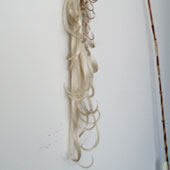
I see in today’s culture everything marketed as product. Even war is
turned into a hot new game and resembles a slick TV ad repeated endlessly
until it becomes your unconscious mantra. We're all suckers for beauty,
and the sparkle of savvy marketing blinds us to what is really going on.
My work also uses glitter and shine to attract, but its intent is to
reveal the truth inside
by poking fun at the glitz.
I love working with synthetic hair, plastics, and fabrics. This is partly
from my past experience as a hairstylist and working in clubs, but also
because they have the ability to act as a veneer to the subject. I’m
fascinated by clouds and stubborn plants sprouting from cement, which is
my limited nature in the city, and I’m hooked on The New Yorker and
National Geographic, whose stories inhabit my work.
My present work illustrates how current events are turned into glittery
products. They are sold as a better, fabulous life, but beware! I don’t
want the world around us to be destroyed by commercial interests, and
hopefully my form of beauty lures you in to look past the facade.
Tali Gai: email
My current work focuses on drawings and paintings that confront the effects
ofinitiation and transition, from one stage of life to the next. The
drawings and
paintings explore what happens when transitions or transitional markers
are not emotionally
absorbed, and explores theconsequences of the fallout. As the drawings
progressed,
they evolved into a visual description of aninternal warfare in which the
enemy is
unknown, a haunting ghost from the subject’s past. Thus, the work speaks of
internal
demons rising to thesurface--whether consciously or unconsciously,
identified
orunidentified. The piece When You Win, I Lose speaks specifically about my
feelings about life as an outsider--a life in which one must persevere
despite
unsympathetic circumstances, situations and people and a life in which one
finds
oneself in utter isolation. The piece expresses feelings of loneliness,
alienation,
fear and also quiet determination and strength of purpose. Similarly,
Self-Portrait
with a Bouquet of Unidentified Emotions highlights taboo feelings--
supressed rage,
haunting memories, and psychological abuse of the child as it awkardly
spills into
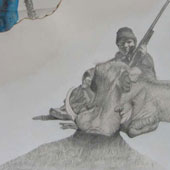
or erupts into one's present adult life. The Boys Are Back in Town
represents a
series of drawings I have done of big game hunters. The images are drawn from
internet sites that advertise safari-adventure type vacations with the
goal of
killing as large a beast as possible and then posing with it. I was
fascinated both
by the need of certain people to engage in this activity as sport and with
the
ritualized posing of the photographs. The need to face death and defeat an
animal
much larger than oneself seemed strange and primal--a way to experience
Sartre's
notion of freedom in terror or Hemingway's notion of freedom in heroic
acts of
courage. It seems that when one is pushed to the edge of experience, to
the height
of one's senses, in a crisis-type situation (which hunting seems to
re-create) a
euphoria is released. The taboo source of this "high" fascinates me on
many levels
in my work--as the notion of feeling alive only when challenged to the
pit of one's
being comes up again and again in my work.
Sydney Hardin: email
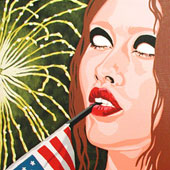
The mainstream media are busy producing remarkably one-dimensional representations of female sexuality aimed at male
and female consumers alike. This over-production speaks to the media’s insidious role in our culture; its airbrush is definitely
obscuring more than mere cellulite, unwanted hair and wrinkles. Media sources such as Vogue and Disney are stunting the
erotic range of women, offering as surrogates a collection of vulnerable, thumb-sucking baby dolls.
“Missing” takes the marketing of female sexual identity to its logical extremes, reflecting both media and consumer blindness
to erotically irrelevant features. I intend “Missing” to create a relationship between my subjects and viewers that is utterly devoid of the enticing relationships created by advertising. I hope this will be an uncomfortable and intensely personal dialogue
between potential voyeur and possible victim.
Jesse M. Kahn: email
The work presented here is part of an attempt to end my armchair activism
and instead actively expose what I feel is a ludicrous level of anxiety
over national and personal security. I also feel compelled to remind the
government and the general public that each and every piece of collateral
damage in war was actually a human being, a person with family and friends
who contributed to our society well before being shipped off to war. I
often employ craft methods and materials typically associated with women
and domesticity, and historically deemed less worthy than work made for
the public sphere by men. With these tools I create work which is
sometimes serious, sometimes filled with humor, but always political.
Edward Middleton
This body of work represents the ills of modern man they turn blind eyes
to everyday of their existence. The medium I have chosen and the subject
I have chosen to photograph are my way of exposing indifference and
ignorance by exploiting an experience most take for granted as a brief
reprieve from their everyday lives. In photographing cinema, under
fiercely strict guidelines placed upon myself, by myself, i have taken advantage of the illusion of fantasy and exposed the inherent truths evident right in front of the people i wish to communicate with.
Lee Foster Powers
I started collecting cards and conceived this piece during college, where
for a
long period of time, I received multiple credit card applications daily.
It made me
think about how many little plastic cards I already had for credit,
identification,
discounts, building/room entry, and more, and how my life is irretrievably
entwined with these cards.
Are our lives really better as a result of these cards? Depending on the
use, a
person can get a drink, buy a car, get in financial peril, or get an
identity stolen.
As the cards piled up in my dorm room, I realized the callousness of sending
them to an historically irresponsible population.
The image of a raised fist, borrowed from the black power movement, is my
response. For this modern enemy, I decided to use a most basic weapon. A
clenched fist, raised in opposition for now, but easily redirected to make
a more forceful point.
Melissa Sullivan: email
This project is a series of images comprised of shop windows in my local
community. It investigates and takes notice of the forgotten (and most
interesting) aspects of the community-local business. With this project I
aim to
revive these lost shops and storefronts to its community members,
regaining energy lost to its competitor- big business. Wherever one is
from, a sense of community, nostalgia, and personal experience is
reflected back to the viewer, causing him/her to think about what s/he is
looking at.
Familiarity is so important in a world that has now become Corporate
America. Big shopping plazas and superstores are swallowing that sense of
community and unique character local business once created. It is my hope
that these vital community spaces are not to be forgotten or taken for
granted. Alluring colors bring new light to the scene as one can see the
beauty and character that is being missed.
Taryn Wells: email
My artwork at this particular time is a dialogue that explores the
complicated world of racial identity and the desire to find my place
within it as a multiracial individual. The basis of the series emanated
from my need to examine the dualities and dark truths of America,
expressing the history of a people that is often overlooked and creating a
parallel with today’s perception of race and yesterday’s reality. The
resulting series communicates a distinctive perspective that is sometimes
sardonic and sometimes somber but always with the intentions of sparking
debate. Even though some of the subject matter may not be familiar, my
belief is that the viewer will recognize something of his own experiences
and somehow relate to the works in the series.
|