Leika Akiyama
In this work I am continuing on my series titled 'Bubbles Bubblicious: A Collection of Dreamy Zen Mandala.' For this show I have created a large size Hello Kitty Mandala surrounded by smaller Bunny/Doll Head Mandalas to pay tribute to my Icon Hello Kitty or Kitty-chan as she is referred to in Japan. In contrast to Western Christian belief where there is one God, Shintoism sees spirits and divinity in nature as well as in objects. I am neither Christian nor a Shintoist, but rather a product of two opposing cultures: the East and the West. I worship mass produced objects and toy characters such as Barbie, Hello Kitty and My Little Pony and I try to put them into Mandalas, a symbol of my personal mythology and universe. By creating a context within which to surround these mass-produced often discarded or trivialized objects I am creating an entrée into my own mystical world in which they can realize their uniqueness and their "isness of things."
Vaughn Bell
My connection with Japanese culture it that of a foreigner with a deep attraction and feeling of kinship, for whatever reason. My fascination encompasses the ritual and meditative traditions, but is especially focused on the Japanese uses of and relationship to the natural landscape. Japanese gardens, and their miniature versions, bonsai, seem to embody this relationship.
Bonsai are cute. These altered, manipulated trees are miniaturized in such a way as to make them humanly controlled, captives to aesthetics. At the same time, their cultivation is a kind of worship, or at least fetishizing, of natural forms and natural processes. Ultimately, though, I think that cuteness is the underlying appeal, and it certainly seems to be a hallmark of contemporary Japanese culture. Cuteness: human beings are programmed to be attracted to anything small and fragile because it resembles a human baby. Hence, I created the baby bonsai carrier. This garment enables the wearer to come closer to nature by breathing, eating, and traveling with the bonsai. At the same time, in an odd reversal the baby bonsai carrier forces the wearer to adapt their body to the tree’s needs, in order to keep it alive.
Todd Fairchild
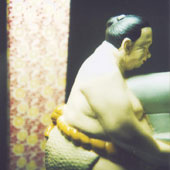
I love and hate clichés. When I'm on the outside of a cliché, it is a feeble attempts to summarize a vast experience in a few words. But, there are times when I find that those few words open an instant connection between myself and thousands of others. Plastic replicas are the same for me, they are lame in comparison to the flesh and blood, yet also are capable of reflecting a deep perspective.
The plastic Sumo wrestler does nothing to convey the incredible mass and strength these athletes posses, and the goofy smile and battery-operate fan undermine the majesty of the tradition. The story it does tell is that of understanding a tradition from another continent and culture; if it crosses the divide through mass-channels, it is processed until it is non-threatening, kitsch and has commercial potential. This process leaves the tradition isolated within our massive current experience.
Amy Goodwin
Most of my recent paintings assemble small disembodied shapes to form a
larger intelligible silhouette. I like grouping many small things for
greater overall optical effect. While painting these works I discovered the
Japanese artist Yayoi Kusama who, for the last fifty years, has incorporated
a stylized dot motif into much of her art. She describes these dot patterns
as “reverberations from an invisible universe.” The two paintings I made for
the Wasabi describe heroic shonen (boy) and shojo (girl) forms with a nod to
Yayoi Kusama’s fantastic vision.
The other pieces I created for Wasabi are inspired by the illuminated
sculptures of Japanese-American Isamu Noguchi. I love glowing objects and I
am drawn to the idea that something is coming from the inside. Noguchi’s
sculptures, or Akari as he referred to them, are made with a traditional
Japanese lantern making techniques combining bamboo and rice paper. I’ve
incorporated these techniques while creating illuminated works bearing
contemporary Japanese Kwaii (cute) iconography
Toru Nakanishi
"These are the images that I found when tryng to look for traditional Japanese style painting that are still being created today. These tatoo belong to younger members of Yakuza. Images are taken with 4" x 5" large format film camera, scanned into the computer, and then manipulated with Photoshop in order to enhance the composition. Final prints are output from Inkjet printer."
Liz Nofziger
A multimedia homage to the beloved heroes of a 70s childhood—a
nostalgic, erotic, violent, spectacle, re-visiting the ground-breaking
Japanese animation, Gatchaman.
"Sometimes they are five...sometimes only one. The mysterious white
shadow that steals close to its prey....they are the Science Ninja
Team."
Kai Vlahos: email
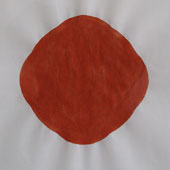
My work embodies the Japanese aesthetic of wabi-sabi, which
stresses the beauty of things imperfect and impermanent. I create
precise, symmetrical forms using simple math and compasses, and
transfer these designs onto rice paper. I then paint the forms with
gouache, either orange or red, and usually apply a final wash of white,
which creates a faint patina. The paper warps and wrinkles and the
color sometimes runs. The distortion of the surface of the paper and
the subtle variations of color are heightened as they contrast with the
perfectly symmetrical design. I feel that the compulsion to aspire to
some sort of perfection is a part of human nature and I incorporate
this into the process through the adherence to a rigid, mathematical
format, but the beauty of the
pieces lie in their deterioration as they distort the delicate surface
of the rice paper and consequently corrupt their own carefully planned
construction.
|