|
Mara Brod: email
Ever since moving to Somerville about 13 years ago, I
have enjoyed walking its small streets and discovering
its hidden pathways, camera in hand. Certain
questions often filter through my mind:
What gives this city its visual character?
What sets it apart from other American spaces?
Alternatively, what binds it to other American spaces?
How can the intangible character and personality of a
place be observed and illustrated through its physical
elements --its structures, colors, landscape and
people?
I am interested in making pictures of and about
Somerville that are visually dynamic and interesting,
but also capture a deeper essence of a place where
people live.
I’ve found that a square, medium format negative, and
a camera with a waist-level view finder produce
effective results for this project, and lend
themselves well to the way I see. Cameras used have
been two twin-lens cameras: a Minolta Autocord and a
Rolleicord.
Nancy Hall Brooks: email
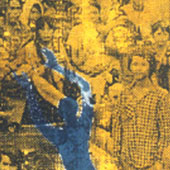
I am intrigued by connections between personal stories and the wider
spheres of politics, history and myth. My prints often include
exaggerated gestures and symbolic imagery to heighten the personal and
social narrative. Balancing Act evokes both the precariousness and the
sense of possibility inherent in starting life in a new land.
Matt Carrano: email
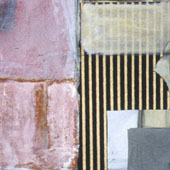
When I moved into my Somerville studio in 1995, one of the first paintings
I produced was called “The Neighborhood.” This painting was inspired by
the visual diversity of the houses and commercial buildings that could be
seen walking through the Spring Hill neighborhood adjacent to my studio on
Central Street. Seven years later, I decided to revisit that theme with a
series of works on paper entitled “The Neighborhood Revisited.” Using my
1995 painting as a point of departure, these works explore the visual
rhythms of urban spaces, and celebrate the urban neighborhood as a setting
that supports the idea of people living together with a sense of
community.
The dictionary definition for the word “neighborhood” suggests that people
living in proximity largely define a neighborhood. I think of the urban
neighborhood as a place where proximity forces its inhabitants to reach
some form of shared identity and understanding enabling them to coexist in
close contact. This requirement to develop a shared identity and
understanding is what leads to a building of a sense of community. From a
visual standpoint, the thing that interests me the most about an urban
neighborhood is the way that the architectural landscape develops
organically. By this I mean that urban communities are rarely completely
planned, but evolve through a series of random developments that occur
over a series of many years. This leads to an endless variety of
unexpected patterns of form and color that have the ability to stimulate
our imagination.
The use of mixed media in this work, including drawing, painting, and
collaged elements applied in layers, references the way in which
Somerville neighborhoods reveal a succession of reinvention and change.
It is also a metaphor for successive waves of people who have found their
way to Somerville over the decades and have come to call it home.
Susan Del Conte: email
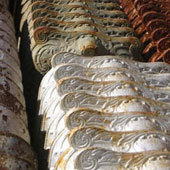
This series of photographs was taken at a location in Somerville
which I fondly refer to as the Radiator Yard. Passing the yard on my ride
home, I have always been intrigued by the vast array of uniquely detailed
radiators. After a while, I began to look forward to my
rides by the yard and started to see the radiators as little friends
waiting over the hill to welcome me home.
Over time I took a more in-depth look at the radiators and began to
notice the sculptural qualities they possess. Their form is both
graceful and industrial, both decorative and functional. Their varied
shapes and sizes endow them with their own physical characteristics. Due
to the passage of time and change in heating technology, what was once
commonplace is no longer manufactured. We are fortunate to have this
unique sea of objects sitting in our backyard. One day in the not too
distant future they will be missing from the landscape, not only of
Somerville but of our modern world.
Beth Driscoll: email
My brother and I have lived in Somerville longer then we’ve ever lived
anywhere else. He bought a small house on a big lot here a very long time
ago .We built a duplex on that land three years back and we live there now
with our four dogs, my brother’s sweetheart, and a good old friend of
ours.
All of my things are out of storage, my books are unpacked and I’ve
planted a garden.
I love my neighborhood and most of my neighbors; I’ve found myself quite
suddenly at home. I guess that’s what these pictures are about, finding
that juncture where a place can intersect and redefine a person’s sense of
what home can be."
Martha Friend: email
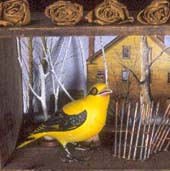
I use a wide variety of materials, including found objects, printed
images, iridescent paint, and organic detritus, to create dioramas and
assemblages that tell a story, evoke a mood, or make a statement about a
larger idea.
“Bird as Big as a House” includes a hand carved yellow bird, dried
roses, and a calendar print of a yellow house.
Historically, birds have migrated in search of a warmer place with bigger
food supplies, and then return to their homes as the seasons change. Now,
with climate changes, fewer do; they live their lives in one place. Humans
are not so different from birds; the need to feed their families and find
security motivates them to travel great distances to new lands in search
of a better life. Some return to their countries of birth, but others
“build their nests” in places like Somerville, hoping their new home will
provide for them. Humans and animals, as they move around and explore,
learn to adapt and coexist.
Alice Grossman: email
For many years I have photographed the semi-private spaces of front yards
and gardens. These are places where people work, play, rest; getting
outside of themselves by connecting with the natural world. It is here,
also, that they transition to the outside world from their own personal
haven. I am interested in the evidence of the human intereaction in the
creation and nurturing of this landscape. Some people totally control
their own small corner of nature, others add ornament or build shrines for
protection and guidance. When I go out to photograph, in my regular walks
in my neighborhood, I find a mysterious, quiet beauty in these places.
There is something enticing and strangely foreboding for me, in both the
subject and in the act of photographing someone’s private property from
the public side of the fence. These images were all taken in my immediate
neighborhood in
Somerville. I use a “Holga” medium format camera, which has an
unpredictable plastic lens. The image falls off in brightness from the
center and is not very sharp anywhere. I scan the film into the computer,
adjust them minimally in Photoshop, and print the images
archivally on Hahnemuhle Photorag paper.
Skye Kismyth Schulte: email
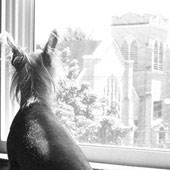
For me, having a dog is a necessary component of making a house feel like
a home. When I got a call from the breeder that a little Chinese Crested
puppy was available for me after waiting almost a year I was thrilled.
Unfortunately, my landlord of three years didn’t feel the same way about
this unique hairless and hypoallergenic dog. I was in a panic…there was
Brandy just waiting for me to pick her up and bring her home and we didn’t
have a place to live! Thankfully, I found a realtor in Davis Square who
helped me to find the perfect place in the dog-friendly town of Somerville
in less than 24 hours!
Now living in Somerville with my two dogs, I truly feel that I have found
a home. My personal migration has brought me to this town that is just as
friendly and open and dynamic as the place where I grew up in Northern
Wisconsin. Not a day goes by that I’m out walking my girls and we meet
someone new or run into a friendly neighbor. I love that sense of
community…that sense of home! I hope that these photographs can share a
bit of the contentment and joy I feel every time I’m out walking ”the
girls” on Powderhouse Boulevard.
|